
Author: Team Editors admin

  • What’s Next After the Emerging-Market Gold Rush Ends?

    What’s Next After the Emerging-Market Gold Rush Ends?

    What's Next After the Emerging-Market Gold Rush Ends?

    A gold mine for marketers through the past decade, developing economies have lost some of their shimmer. The past year has shaved two to three percentage points off growth rates for countries such as China and India. By most projections, emerging markets are never again likely to grow as fast as they have the past two decades.

    That’s leading some marketers and agency executives to shift their gold-rush mentality to a more measured one where they’re placing bets on the most-profitable markets and doubling down in the U.S.

    “The easy growing is done,” said Sanford C. Bernstein consumer-goods analyst Ali Dibadj. “Now comes the hard part.”

    In the third quarter, China was a sore spot for companies from McDonald’s to Mondelez; Pernod Ricard and Remy Cointreau also reported weaker sales in the country for the quarter. Heineken posted volume growth in Asia, but saw declines in Africa and the Middle East that it blamed on social unrest in Egypt and economic softness in Nigeria. India, Brazil and Mexico also dented results for many.

    “With all the excitement in recent years about the potential for growth in emerging markets,” said Nestlé Chief Financial Officer Wan Ling Martello in the company’s most recent earnings call, “it is sometimes forgotten that developed markets account for around 50% of the world economy.”

    Consumer Edge Research CEO Bill Pecoriello said concerns about slowing developing-market growth have been weighing on stocks of the heaviest players there, including Unilever and Avon Products. The companies still finding substantial growth in developing markets, such as L’Oréal, Estée Lauder and Kimberly-Clark Corp., have been doing so through distribution gains, said Mr. Dibadj, but lapping those results can make growth targets harder to reach the following year.

    Even so, developing markets remain the most-promising prospects for marketers. “When emerging markets still represent 81% of the growth potential, what other choice do you have?” asked Mr. Pecoriello.
    Emerging markets are still such a big opportunity that it’s impossible to divert resources, even though they likely won’t deliver the same bang for the buck as in years past. The solution for marketers may be to trim more aggressive growth plans and concentrate on the most-profitable opportunities within those markets while renewing focus on the U.S.

    Taking on Unilever
    P&G made that step last year to prioritize its 40 category-country combinations, which are heavy on the U.S. and China. The plan shows some signs of working. A year ago, P&G saw essentially flat growth in the U.S. and double-digit growth in developing markets as it lagged its key competitors globally in growth. Last quarter, P&G had 2% growth in the U.S., 8% growth in developing markets, and 4% organic sales growth overall, which was good enough to beat Unilever and tie L’Oréal, two companies P&G has been trailing for years.

    P&G has far from given up on developing markets. It recently launched Old Spice in India and laundry initiatives in Brazil, taking on Unilever in two of its strongholds. Even so, fixing the troubled Pantene and Olay brands in the U.S. remains a top priority.

    “Our strongest business units and total company positions are in the U.S.,” P&G Chairman-CEO A.G. Lafley said at the company’s annual shareholder meeting last month. “We need to ensure our home market stays strong and stays growing.” That said, “developing markets driven by demographic and household income growth will continue to be a significant growth driver for our company.”

    Similarly, Walmart is scaling back growth plans in Mexico and India and closing some stores to focus on profitability in China and Brazil. It’s also exploring prospects in the U.S., stepping up store growth in recent years, particularly with smaller stores.

    Walmart dissolved a joint venture in India last month because of regulations that would inhibit growth, Walmart International CEO Doug McMillon told analysts, though it retains 20 cash-and-carry stores there. He said the company still believes in India.

    The company also downsized its global growth plans for the coming fiscal year to 14 million square feet from as much as 22 million square feet to reflect those store closings in China and Brazil.

    Walmart, meanwhile, has been banking more on the U.S. It held a summit in August aimed at getting suppliers to open more manufacturing facilities in the U.S. both as a way to shorten supply chains and save money and help strengthen the U.S. middle class, as Walmart U.S. CEO Bill Simon put it.

    Those moves could position Walmart for what Boston Consulting Group sees as a key factor that will reshape the global economy in the back half of this decade — “re-shoring” of manufacturing to the U.S. that could ultimately add 2.5 million to 5 million jobs and shave 1.5 percentage points off the unemployment rate, though it will also inhibit growth in some developing markets.

    The economics of manufacturing have shifted so much in recent years in computers and electronics, home appliances, plastics and car parts that it’s getting to be cost effective to manufacture in the U.S. again. Among the factors contributing to that: rising wages in China; the cost of shipping and supply-chain disruptions; and cheaper energy in the U.S. due to rising domestic oil and gas production.

    Even so, Harold Sirkin, senior partner of Boston Consulting, said this is no time to abandon China. “The reality is that China will not be closing plants as part of this,” he said. “While China may not build as many plants as before, the economy will still grow 5% to 7.5% annually as it shifts toward domestic production and consumption,” he said. “But even 5% to 7.5% gets you a lot of growth from a large base.”

    The re-shoring issue is one reason for the slowdown in developing markets that began last year and could be more than a temporary blip.

    The gross domestic product growth gap between the U.S. and developing markets in Asia, for example, more than doubled to 7.8 points between 2005 to 2011 from 3.7 percentage points between 1995 and 2004. But last year, the gap narrowed to 3.6 points, a level the International Monetary Fund projects by 2018 as well.

    The narrative about slower emerging-market growth is spilling over to the agency world, where Publicis Groupe CEO Maurice Levy acknowledged in an earnings release last month that emerging markets had slowed while developed ones had picked up over the last quarter, though he expected developing markets to pick up the pace this quarter.

    Still, while the party had to get quieter, it’s not entirely over. “We’ve been warning of a slowdown in emerging markets for a while,” Unilever CEO Paul Polman said on the company’s Oct. 24 sales-update call, adding that while Unilever is growing ahead of its markets, the slowdown is finally taking a toll on a company that gets close to an industry-leading 57% of sales from emerging markets.

    But developing markets are still where 80% of the world population is, Mr. Polman noted in an email to Advertising Age. “Growth rates will slow down, because the base is getting higher,” he said. But he added: “There is still plenty of growth if we figure out how to do it sustainably and equitably.”
  • Top Five Reasons For Gold Trading

    Top Five Reasons For Gold Trading

    Top Five Reasons For Gold Trading

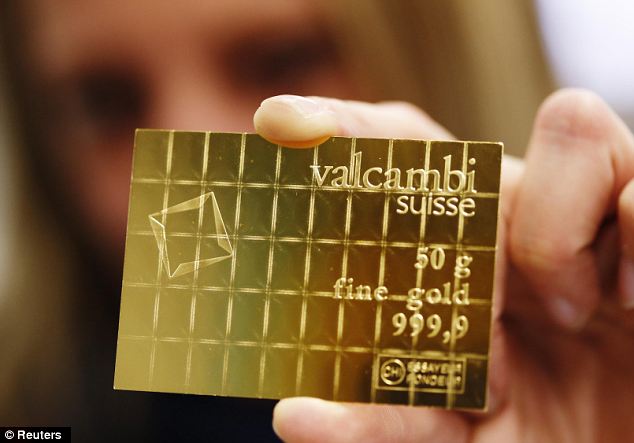
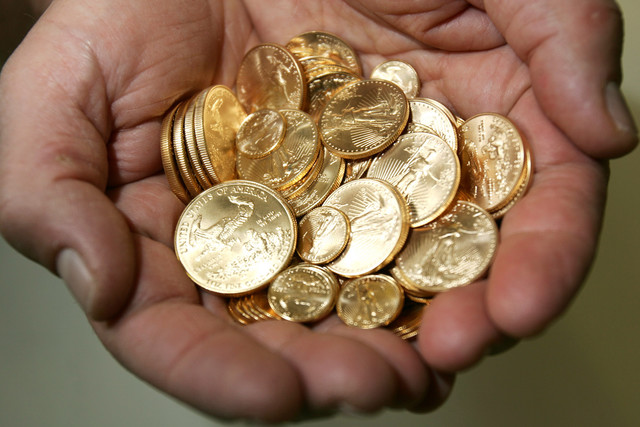
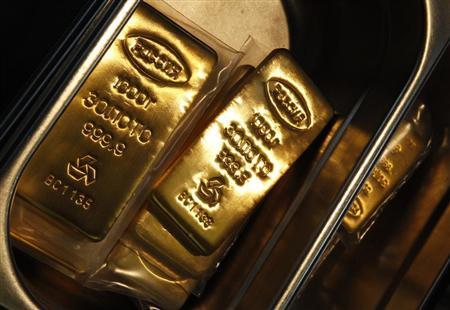
    Gold trading is becoming more and more important for many reasons.Gold is more than just an inexpensive way to decorate your neck or fingers. Gold is used in dental coverage and as a conductive material will not be subject to erosion and help in the transfer of information in electronic form from one place to another.

    Gold is used in helping to build a spacecraft that need to be stronger and more durable materials. Even that gold is used in the medical aspects of treatment as part of the line for some forms of cancer and rheumatoid arthritis. But in addition to its uses concrete, gold is known as one of the most traded on the equivalent of a large scale, because it is considered historically safe investments and which are not prone to dramatic fluctuations based on market fluctuations or movements of any major currency.

    Fortunately, the trading of gold is not available for governments and financial institutions only, as it is an important option available to individual investors around the world, those who are looking for a way to take advantage of this asset safe. If you are not familiar with the benefits of trading gold, the thought of the following five reasons to buy gold.

    1- Inflation protection: In gold trading, the value of gold tends to rise with the increase in the cost of living, which means that it is protected from inflation. If thrown a quick look at the history of the U.S. stock market, you will see that in times of high inflation, fell Mair Dow Jones Industrial Average, while the cost of gold remained stable, if not higher than normal. Accordingly, anyone who has a concern about the impact of inflation on their investment returns him to think of investing in gold.

    2- Gold helps to diversify the investment portfolio: any decent financial adviser will tell you that it is very important to have a diverse list of assets in the investment portfolio. Although some people believe that diversity is calculated only when it is in the form of a mixture of stocks, bonds or CFDs or currencies, but gold trading is an excellent way to add a new dimension to the investment portfolio, and to add a bit of stability even in the province dangerous.

    3- Gold is immune to crises geopolitical: Although the currency values ​​and stock prices tend to fluctuate depending on the political climate in a particular country at a particular time, trading gold because it tends to resist such price changes dramatic, and that makes it a strong option for anyone with concerns that the state of the currency could be in danger or who has a concern that their currency may lose its value for any reason at the time that they desperately need.

    4- Limited production increases the value: Unlike currencies, where the leaders of governments to intervene by injecting more money almost immediately, the production of gold is a tedious process and you may need to years. In gold trading, for this reason, every few years there is no time exceed the demand for supply, leading to a rise in the value of gold.

    5- Gold has a history: Even a quick outlook on market patterns will indicate that all currencies fall dramatically at a time, and that global Equity markets fell as well. However, gold is a metal maintained its value since thousands of years. Gold is considered a valuable biblical time ago, and it remained until the present time. Although the price does not always rise, but gold has never tested a long-term decline in the value as is the case with all of the major currencies throughout history, including the U.S. dollar. For these and other reasons, too, the gold trading becomes more popular day after day.

  • UAE gold sales rise by 11.6%

    UAE gold sales rise by 11.6%

    UAE gold sales rise by 11.6%

    In a report released by the World Gold Council, declare the higher gold sales in the UAE during the first nine months of this year by 11.6% to reach AED 10.3 billion, compared to AED 9.2 billion during the corresponding period of last year.

    WGC said that Quantity sold in the domestic market during the period referred to amounted to 58.3 tons compared to 47.3 tons during the corresponding period of last year.

    The increased demand for jewelry and bullion during the period from January to September by about 23.7% in terms of volume, up from 40.5 tons in 2012, to 50.1 tons during the current year, while the recorded works in terms of value growth of almost 10.8 percent to 8.76 billion dirhams.

    The data showed the third quarter to achieve investing in gold state growth rate of 8% in terms of value, reaching $ 115 million, compared to $ 106 million during the third quarter of last year, has grown quantities sold at this level by 35% to reach 2.7 tons during the quarter third versus two tons during the corresponding period of last year.

  • Gold Fell With Decline In Demand And Rise Of  Equity

    Gold Fell With Decline In Demand And Rise Of Equity

    Gold Fell With Decline In Demand And Rise Of  Equity

    The price of gold fell on Monday after recovery pushed stocks and weak demand traders to profit from three days of gains , although for the precious metal on the support of speculation constantly monetary stimulus from the Federal Reserve ( Fed ) .

    The speculation that helped Janet Yellen the next president of the Federal Reserve policy of monetary easing will continue to support gold last week, but encountered stiff resistance at about 1294 dollars per ounce .

    On the stock markets rebound concentration of some investors away from gold.

    The Inn Spot gold 0.7 percent to $ 1281.26 an ounce by the time of 1524 GMT . The price of the precious metal rose more than $ 20 an ounce in the past three days after he scored on Tuesday , the lowest level in the month of $ 1260.89 an ounce.

    Futures fell U.S. gold for delivery in December $ 6.50 an ounce to $ 1280.90 an ounce.

    I got silver in online transactions 0.9 percent to 20.57 dollars an ounce as platinum fell 1.4 percent to 1417 dollars and 1.7 percent palladium $ 718.22 an ounce

  • Gold Falls After 3 Days Gains

    Gold Falls After 3 Days Gains

    Gold Falls After 3 Days Gains

    Gold tends to end a rally that lasted for three days on Monday, but the prices are stable near $ 1,300 an ounce , thanks to hopes that keeps the Federal Reserve (Fed ) monetary easing policy enhances the lure of the yellow metal as a hedge against inflation .

    The Inn Spot gold up 0.2 percent to $ 1286.96 an ounce by 0741 GMT . The price of the precious metal rose two percent in the past three days , thanks to expectations that Janet Yellen candidate for the presidency of the Fed will keep the bond purchase program worth $ 85 billion per month.

    Gold lost 25 percent of its value since the beginning of the year as a result of fears of reduced stock purchase program Booster Gold with the improvement of the U.S. economy.

    And silver fell 0.5 percent to $ 20.66 an ounce and platinum also fell 0.27 percent to $ 1433.6 and palladium 0.56 percent 726.22 dollars an ounce

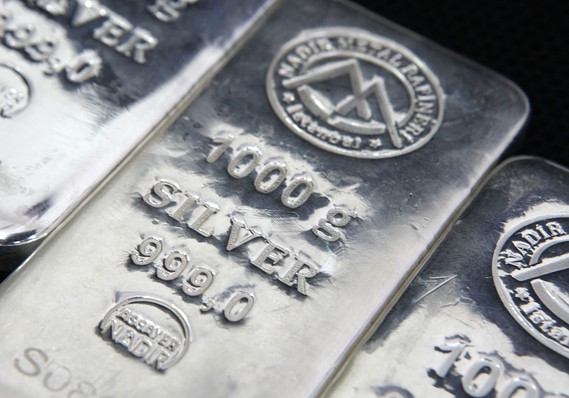
  • Silver near  third weekly loss in a row

    Silver near third weekly loss in a row

    Silver

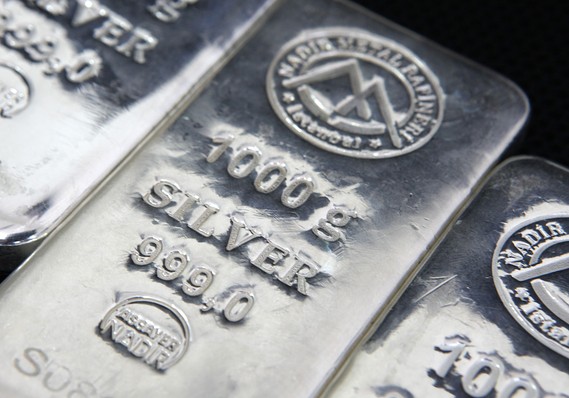
    Silver fell on Friday amid a slowdown in investor demand for safe havens tools and especially the precious metals in the face of rising U.S. currency dollar and a strong rally in global equity markets, and silver tend to achieve a third weekly loss in a row.

    Silver ended trading on Thursday on the rise by 0.9 percent within the correction after falling to its lowest level in three months 20.43 dollars an ounce, the first on Wednesday.

    By 09:30 and met GMT fallen silver to $ 20.62 an ounce after the opening of the trading day at $ 20.76 , the highest recorded level of $ 20.84 and the lowest level of 20.56 dollars.

    Dollar Index

    The dollar index on Friday rose 0.2 percent , thanks to higher U.S. currency against the yen recorded the highest level in two months 100.42 yen per dollar , while the euro fell for the second day against the U.S. dollar .

    Global Equity

    Achieved a major indexes on Wall Street with the end of yesterday ‘s meeting new highs thanks to rising risk appetite among investors in the light of expectations to retain the stimulus program after Janet Yellen ‘s remarks , rose today futures for the S & P 500 by about 0.2 percent.

    MSCI index of Asian shares 1.3 percent , exceeding the Nikkei Stock Average Japanese level of 15,000 points for the first time in six months , and recorded its biggest weekly gain in four years, and increased the broader Topix index 1.7 percent to close at 1239.04 points

  • Market Outlook Today  15/11/2013

    Market Outlook Today 15/11/2013

    Janet Yellen defended its comments stimulus for the U.S. central bank, and boosted risk appetite and Wall Street reached record highs on Thursday.

    The U.S. trade deficit expanded to $ 41.8 billion in September from a deficit of USD38.7 billion in August.

    came out euro fell against the dollar after weak GDP in the euro zone. The data showed growth in the third quarter from a 0.1 percent rise.

    The finance ministers will meet in Brussels for a second day on the outline plans for dealing with the banks that are still difficult. The British Pound was under pressure after disappointing retail sales data in the United Kingdom on Thursday.

    Retail sales fell 0.7 % in October , compared with expectations for a 0.1 % increase . Recovery of stocks hurt the yen , which hit 2 – MTH low versus the dollar, in the second week against the euro, and the yen’s weakness more so after the finance minister said Aso said the country has custody intervene in the currency as a policy tool .

    Canada ‘s trade deficit fell more than expected in September for CAD 0.44 billion from a deficit of CAD1.09 billion in August . Following the release of the data, the Canadian dollar remained lower against its U.S. counterpart .

    In commodity markets, Brent crude for the third consecutive amid concerns about crude supply disruption in Libya. Gold prices fell slightly in Asia on Friday as investors sought to take from moving between gains overnight on expectations of continued easy monetary policy in the United States

    Calendar quiet compared to Wednesday and Thursday. It is estimated in the euro zone the final consumer price index for the month of October that up to 0.7% on an annual basis, the same as the initial number. in the United States, is expected to rise to 5.00 from 1.52 industrial production for the month of October to be up 0.2% on a monthly basis, a slowdown from 0.6% in September to the Empire State Manufacturing Survey for the month of November. We have only two speakers today by the European Central Bank. , the European Central Bank is talking about monetary policy, while the ECB speaks at the annual conference of 6 CFA Institute European Investment.

  • Technical Analysis for silver 15/11/2013

    Technical Analysis for silver 15/11/2013

    Technical Analysis for silver

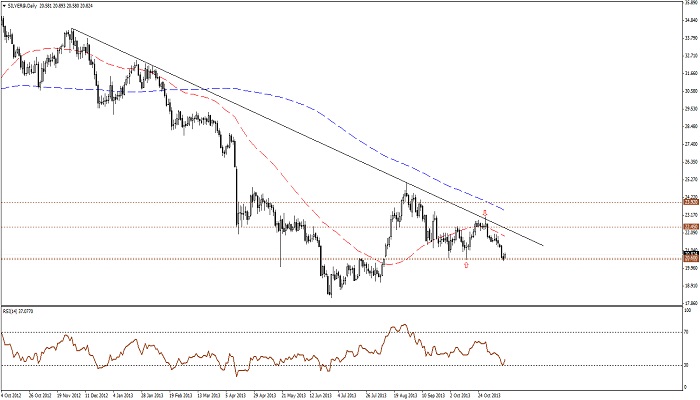
    Silver stayed weak in marginally with the price fails in gain momentum after the tested support levels at 20.60-20.50, showed signs of weakness yesterday.

    Based on that we expect the resumption of the bearish tendency to be resumed today, with the expectation to break the price levels of 20.50 to confirm more from relegation.

    The short-term trend: both sides of the
    Intraday direction: both sides of the

    Support 20.60 20.25 20.00 19.50 19.20

    Resistance 20.85 21.05 21.35 21.55 21.75

  • Gold Price in Dubai drops To Dh 144 Per Gram

    Gold Price in Dubai

    Gold prices in Dubai dropped this week, nearly five AED per gram where gram 22 carat settled at 144 AED in today’s trading in the gold markets in Dubai

    Gold prices in the UAE for Gram 24-carat DH 152 , gram 22 carat DH 144 , Gram- 21 carat DH 136 and settled gram 18 carat DH 116 .

    Gold settled market European near the top of the level just before the Janet Yellen Vice-President of the Federal Reserve to provide testimony on monetary policy to the Council before the U.S. Congress, showed remarks prepared for testimony that softens think it is still in front of the Federal Reserve work to do to help the economy.

    Gold prices were fell by a sharp decline in four sessions until Tuesday after strong data for the U.S. economy and job growth, sparking fears that the Fed may begin to reduce the bias in December procedures

  • Daily Report For Gold 15/11/2013

    Daily Report For Gold 15/11/2013

    Daily Report For Gold 15/11/2013

    Gold prices rose for a third straight day as part of a corrective movements taking place in prices now, amid investors’ access to markets, especially after gold prices reached their lowest levels since about a month ago.

    From the other side has been affected by the price of the precious metal positive statements issued by the U.S. economy, which in turn contributed to reducing the gains of the U.S. Dollar Index, which has an inverse relationship with gold.

    Statements Janet Yellen, which was nominated formally for the position of Governor of the Federal Reserve next year, also contributed to pay the price of gold, where she softens it is imperative that the U.S. economy is improving before you start cutting policies of quantitative easing, and indicated that the economy is making progress, but the unemployment rate around 7.3% stilltoo high and inflation low for acceptable levels at 2.0%., which means that the Fed will postpone doing downsizing program of quantitative easing.

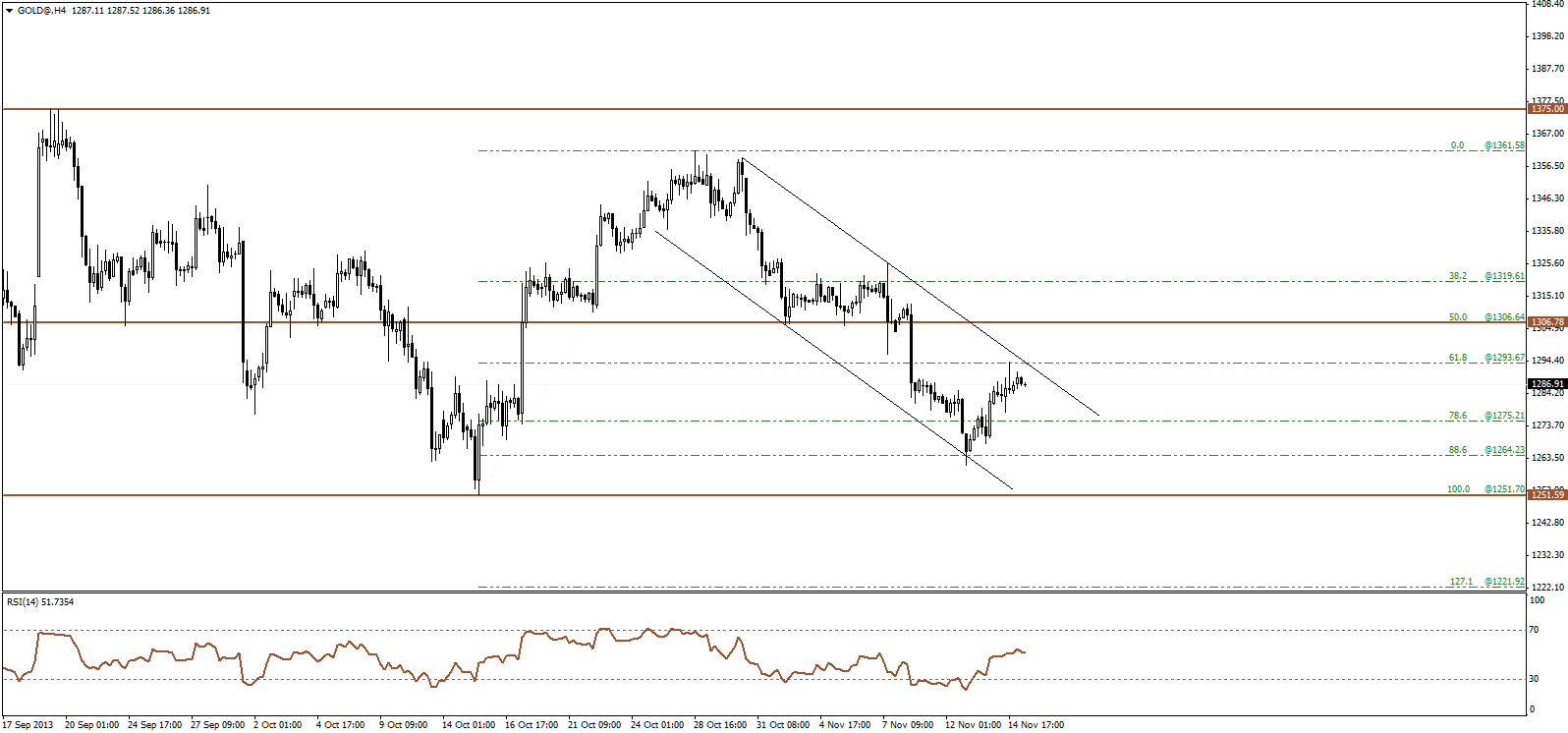
    Gold re-test the top of the main descending channel as was expected earlier, where he found a strong price resistance levels, seeking to resume a downward trend, as we expect to be bearish tendency appeal today from levels below 1295.00, with target levels of 1278.00 and 1268.00.

    Support 1280.00 1275.00 1264.00 1252.00 1240.00
    Resistance 1290.00 1296.00 1300.00 1306.00 1320.00