Blog

  • Gold falls for 2nd week but manages to hold above 30K

    Gold falls for 2nd week but manages to hold above 30K

    Gold falls for 2nd week but manages to hold above 30K

    Both the precious metals, gold and silver prices slid for the second straight week in the bullion market on sustained selling by stockists on sluggish demand.

    However, fag-end strong recovery on low level buying influenced by firming global trend, minimised the losses.

    Traders said sustained selling by stockists due to subdued demand mainly helped both gold and silver prices to surrender further ground.

    Selling by stockists came in at a time when the market was passing through an off marriage season and the government hiked tariff value on gold import, dampening the sentiment, they said.

    A fag-end sharp upsurge of Rs 470 per ten gram on firming global trend mainly pushed up the prices to wipe off most of the losses. The gold rebounded from 10-month low in New York as lower US job data, boosted prospects that Federal Reserve might take more steps to spur growth.

    In the national capital, gold of 99.9 and 99.5 percent purity commenced higher at Rs 30,200 and Rs 30,000 per ten grams but soon met with heavy sell-off triggered by a weak global trend and tumbled to touch a ten month low of Rs 29,500 and Rs 29,300 per ten grams.

    On last trading session, it staged a strong recovery on the back of firm global cues and ended at Rs 30,030 and Rs 29,830 per ten grams respectively, still showing a modest fall of Rs 40 each from the previous week’s close. Sovereign lost Rs 150 at Rs 25,100 per piece of eight gram.

    In line with a general weak trend, silver ready dropped by Rs 1100 to Rs 52,400 per kg and weekly-based delivery by Rs 1360 to Rs 51,540 per kg during this week.

    Silver coins also fell by Rs 1000 to Rs 80,000 for buying and Rs 81,000 for selling of 100 pieces.

  • 5 reasons why Gold may end up well below $1,000

    5 reasons why Gold may end up well below $1,000

    5 reasons why Gold may end up well below $1,000

    On Friday, the price of an ounce of solid gold tanked below $1,550 per ounce, to an 11-month low of $1,549.57 per ounce, prompting a section of analysts to suggest the end of the golden era for the yellow metal.

    It recovered about $30 or so after the market officially closed for the weekend and an ounce of gold was last seen changing hands for $1,581.30 on Saturday afternoon.

    But does that 2 per cent recovery mean all’s well with gold?

    Not even close.

    For the first time since 2001, the price of gold has seen losses for two consecutive quarters. That’s the definition of being in technical recession – down for two consecutive quarters. Gold price is now down 6 per cent in 2013 (rose just 7 per cent in the whole of 2012).

    This means that, at least over the past 15 months, it has offered meaner returns than a decent fixed deposit account.

    Indeed, gold is within shouting distance of being officially in a bear market, which it will be when (not if) it falls 20 per cent below the $1,920/oz all-time high that it made in September 2011. For that, the price of gold will need to go down to $1/536/oz or below.

    With the kind of volatility and downward pressure witnessed in gold price of late, that might happen before my next paycheque becomes due.

    To be fair, gold has made a remarkable journey over the past couple of decades. In fact, the past 10 years have seen gold climb from $320/oz in 2003 to $1,920/oz in September 2011 to the current levels of around $1,575/oz.

    But in the world of finance, anything that goes up must come down. And it seems that reality is catching up with gold.

    For one, the rest of the financial world, which was witnessing tsunami after tsunami even as the island of gold was getting greener, is now heading back on track, very gradually though.

    But as any smart investor worth his dime will know, you can only make serious money if you start at the beginning of a rising wave, and cash out near the top.

    Equity markets are at the beginning of that wave, and gold is on the top, and falling. So gold investors – the not-so-loyal but still smart ones – are cashing out their bullion bars and trading them in for stocks in stabilising as well emerging markets.

    This trend, once it catches up in the right earnest, will only result in gold continuing to decline, and the decline will get only steeper as more investors jump off the golden bandwagon and off to more ‘riskier’ assets.

    Indeed, with the recent volatility, gold has ceased to be the safe haven investment, which was its USP and acted as a magnet for countless investors. With such investors giving gold investment a second, doubtful thought, gold has lost a lot of its ‘safe’ gloss.

    Moreover, the infamous US quantitative easing program (which has been mimicked by a number of other countries that either peg their currencies with the dollar or loosely track the US fiscal policy) is going to end – sooner than later.

    The US Federal Reserve has looked for and found unique ways of printing additional money. Indeed, it has poured more than $3 trillion of easy money into the US in the past 51 months since December 2008, when the first round of quantitative easing program was unleashed.

    A good percentage of this endless printing of money found its way into gold ETFs and the likes. In less than 5 years, that $85 billion a month additional money has almost doubled gold price from $837/oz.

    The drying up of this dollar river will only be negative for gold price, with analysts suggesting a rollback in prices to the pre-QE era.

    Paper gold (a.k.a exchange traded funds, or ETFs) has been primary catalyst in pushing up the prices of the yellow metal. It’s what made it possible for retail investors across the world to buy up as little as 1 gram of gold without the risk and cost of holding on to physical gold, and offering the flexibility of trading it like a typical share.

    Gold ETFs were introduced in March 2003, when gold price was hovering around $330/oz. Gold has since rallied by 385 per cent, and 45 gold ETFs have sprung up across the globe.

    The convenience offered by ETFs – of entering into the market in small or big denominations, risk-free storage, and the freedom to exit at will – is what is now being blamed for what some forecasters reckon will be a record plunge in record time.

    In fact, in the first quarter of 2013, gold ETFs experienced record outflows. According to Reuters, which tracks eight gold-backed exchange traded products (ETPs), funds suffered their biggest ever outflows this quarter, falling by 7.2 per cent from the start of the year to 70.66 million ounces.

    With equities rising – and expected to continue doing so in the foreseeable future – investors have been busy swapping their ETFs and gold bars for shares and other tradable securities.

    Indeed, the future of bullion looks bleak.

    Unless, of course, the two Koreas actually go to war.

  • 112% growth in trading DGCX  during the first quarter of the year

    112% growth in trading DGCX during the first quarter of the year

    112% growth in trading DGCX  during the first quarter of the year

    rose volume of trading in Dubai Gold and commodities during the first quarter of 2013 by about 112% in the first quarter of 2012 registered, to more than $ 3.28 million contract, according to a report issued by the stock exchange yesterday.

    The volume of trading in March 2013 by 95% compared with March 2012, recording 1.07 million contract.

    Currency contracts achieved in March rose by 102% on the same month last year, driven by active trades on the Indian Rupee futures contract which has maintained strong growth rates during the first quarter. The number of Indian Rupee futures contracts were traded in March, 1.01 million contracts, an increase of 104% on the same month last year.

    Continued gold futures contracts in the Dubai Gold and commodities strong performance since the beginning of the year registered a thousand 139.91 held by the end of the first quarter, an increase of 47% on an annual basis. The continued growth of silver futures registered an annual increase of 33%.

    Said Gary Anderson, CEO of the Dubai Gold and Commodities: «thanks to the availability of liquidity and price differences narrow in their contracts, will contribute to the strong growth achieved by Dubai Gold and commodities during the first quarter to provide a good platform to achieve stronger growth during the remaining months of the year. It also contributes to the growth of major products along with our new advanced platform ‘platform trader EOS’ in attracting a growing variety of participants for trading on the Dubai Gold and goods from all over the world.

    In terms of contracts for other currencies that have achieved a strong performance during the month of March 2013, has seen trading volumes for Euro – U.S. dollar futures grew by 90% from March 2012, an increase of 282% since the beginning of the year, also achieved decades Yen – Euro futures monthly increase rate of 25 %.

  • Kaloti to build Middle East’s biggest gold refinery and mint in Dubai

    Kaloti to build Middle East’s biggest gold refinery and mint in Dubai

    Kaloti to build Middle East's biggest gold refinery and mint in Dubai

    Kaloti Jewellery Group is to build the biggest gold refinery and mint in the Middle East on a site close to the Dubai Multi Commodities Centre, The National can reveal.

    The state-of-the-art plant, which is expected to be completed late next year, will cost as much as US$60 million (Dh220.3m) to build.

    The new facility, which will be part of the Jumeirah Lakes Towers Free Zone, was unveiled last night as Kaloti celebrated its 25th anniversary.

    “This represents a major investment in expanding and upgrading our refining facilities. This will be a state-of-the-art refinery to rival the best in the world,” said Munir Kaloti, the chairman of Kaloti Jewellery Group. “It will strengthen our ability to meet the growing international demand for our products as well as give us capacity for growth in the years ahead.”

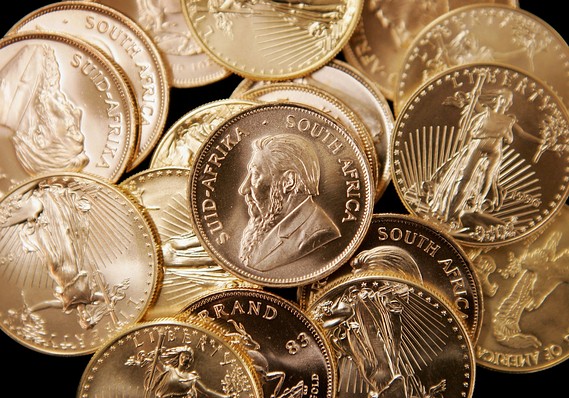
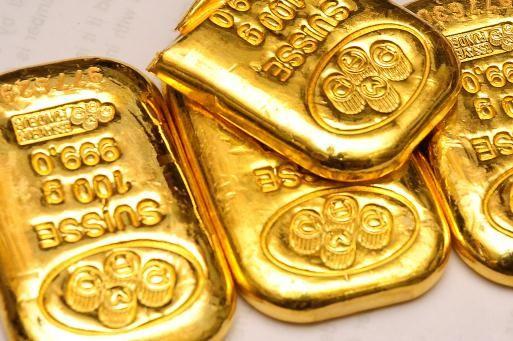
    The refinery will have a capacity to produce up to 1,400 tonnes of gold and 600 tonnes of silver and other precious metals a year. The mint department will produce a range of gold ingots and coins made of investment grade 999.9 purity gold, known as four-nine in the trade.
    The factory will enable Kaloti to triple its current refinery production and will help the company to meet rising demand.
    Global gold refiners and mints have enjoyed a steep increase in business since the start of the economic downturn in 2008. Gold is regarded as a safe haven investment during tough times, a factor that has led the price of the precious metal to almost double from about $890 a troy ounce at the time of the crash in 2008 to around $1,600 today.

    The Dubai gold trade has charted a similarly stellar trajectory in the past five years, with the Dubai Multi Commodities Centre cashing in on the yellow metal’s increasing popularity. The emirate’s gold trade was worth just $6 billion in 2003, according to DMCC data. By 2011, $56bn was traded, made up of $33bn in imports and $23bn in exports.

    The Dubai Gold & Commodities Exchange is also planning to launch a spot gold contract by the end of the year, which requires a large presence of physical gold warehoused nearby in order to function.
    It is understood that the enlarged Kaloti refinery will have a role to play in the spot gold project.
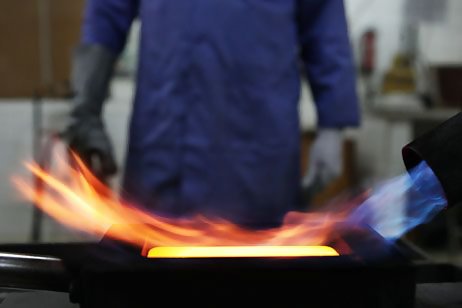
    The new Kaloti refinery will use the latest gold electrolysis technology from Italy and Switzerland as well as the aqua regiaprocess for gold refining. Aqua regia uses a mixture of nitric acid and hydrochloric acid to liquefy gold, enabling the refinery to remove virtually all impurities.
    The plant will also have two assaying laboratories, where the precious metal is tested for authenticity and to ensure it meets the “four-nine” investment grade quality.

    Gold refining is an incredibly costly process using huge amounts of electricity, gas and chemicals. The Kaloti group insists, however, that the new facility meets the most rigorous environmental standards.
    “Our desire to build an energy efficient, socially sustainable refinery fits in with our principal commitment of ensuring the responsible and ethical sourcing of precious metals,” said Mr Kaloti.

    “We strive to guarantee all metals sourced conform to the highest standards set out by government and trade associations.”

  • 22 carats gold price Down to 174 AED

    22 carats gold price Down to 174 AED

    22 carats gold price Down to 174 AED

    DUbai Gold Rate – Gold Prices in dubai down this week by 5-7 AED per gram compared to gold rates by end of the previous week, according to the Dubai Gold & Commodities Exchange .

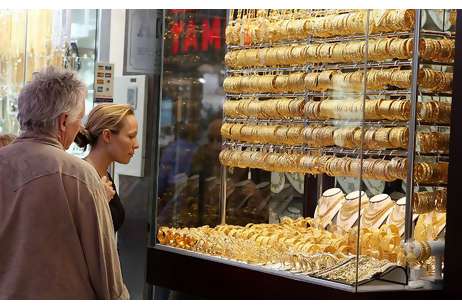
    Gold trader in Dubai said that the declines in prices, contributed to the improved demand for purchase, and lifted sales of works by up to ‬ 20%, arguing that the rates of decline price paid large number of dealers to buy gold, in preparation for weddings and holidays Summer , especially as the gold prices before rates achieved recent declines were in the range of positive, compared to prices during the months of January and February.

    And detailed, the price of gram (‬ 24) carats yesterday was ‬ 185.25 dirhams, down ‬ 6.75 dirhams by the end of the previous week, while the price of Gram (‬ 22) carats, ‬ 174 dirhams, down ‬ 6.75 dirhams, and arrived gram (21) carats to 165.5 dirhams, down 5.5 dirhams, and the price of Gram (18) carat 142 dirhams, down 5.25 dirhams.

    Gold and Jewelry trader in Dubai said that «outlets selling jewelery experiencing an upswing by dealers to purchase, in an attempt to take advantage of falling prices about six dirhams per gram», indicating that «prices did not check their current itself, since a long time.

    Added that «sales of jewelery and gold coins recorded a growth ranging between 15 20%, supported by the turnout dealers are preparing for weddings and summer holidays», indicating that most of the sales were to buyers from Arab nationalities.

    And they confirm «Gold prices recorded declines at high rates, which contributed to raising the sales works towards ‬ 20%, especially as the prices even before the decline weekly latter was in good levels for buyers as It was less than the prices of January and February, expected to register sales growth in larger proportions, if prices continue at rates close in the coming days.

  • Weekly Report for the global metal markets

    Weekly Report for the global metal markets

    Gold increases gains after U.S. jobs data

    Gold prices rose the end of the week after U.S. jobs data came in much weaker than expected, which fueled expectations that the Federal Reserve continues its program of asset purchases. The precious metal rebounded from three consecutive sessions of sharp losses after the Labor Department said that U.S. job growth outside the agricultural sector recorded in the March / March, the slowest pace in nine months.

    The price of gold for immediate sale 8.1 percent to $ 30.1580 an ounce in late trading on the New York market, extending a recovery from the lowest level in ten months, which struck earlier this week.

    And U.S. futures rose gold for delivery in June 50 .23 dollars to record settled at $ 90.1575 an ounce.

    Among other precious metals silver jumped 5.1 percent to $ 30.27 an ounce, platinum rose 8.0 percent to $ 50.1531 an ounce, while palladium settled at $ 22.724 an ounce

    But on Thursday, gold has recorded its lowest level in 10 months with the rise of the dollar as it dropped $ 1540 price without scoring in the spot market to $ 74.1539 an ounce, its lowest level since May 30, down 7.0 percent from the previous session.

    The U.S. gold futures fell delivery in June 4.0 percent to $ 70.1546 an ounce.

    Among other precious metals silver fell to the lowest price since July 24 at $ 65.26 an ounce, then recovered slightly to $ 82.26 low 3.0 percent from the previous session.

    Platinum fell to its lowest level since late August / August at $ 50.1504, while palladium hostel 8.1 percent to $ 50.736 an ounce

     Gold prices fell on Wednesday to its lowest level in nine months with the increase in oil and stock losses which triggered sales in the commodity markets.

    The yellow metal fell during the session and briefly about the level of 1550 dollars per ounce for the first time this year.

    Gold came under strong selling pressure after government data showed an increase in crude oil inventories in the United States, referring to the decline in demand for fuel in the largest oil consumer in the world. The price of gold for immediate sale at the end of the trading session in New York 89.1555 dollars an ounce, down 2.1 percent from the previous closing level.

    In the earlier meeting, the price dropped 7.1 percent to $ 69.1549 an ounce, the lowest level since June 28 / June 2012.

     And U.S. futures fell gold for delivery in April 30 .22 dollars to record settled at $ 80.1552 an ounce.

    Among other precious metals price of silver for immediate sale in late trading in New York $ 98.26 an ounce, down 8.0 percent from the previous close, after it had fallen earlier in the session 6.1 percent to $ 72.26 an ounce, the lowest level since July 2012.

    The price of platinum for immediate sale 2.2 percent to $ 99.1534 an ounce after hitting earlier in the session 1527 dollars, its lowest level this year. The price of palladium fell 6.1 percent to $ 97.751 an ounce. Gold prices fell more than one percent on Tuesday to its lowest level in two and a half weeks because of the rise in the dollar index to its highest level in the meeting and increase the demand for assets that are considered high risk, such as European equities.

    Spot gold fell to $ 89.1581 an ounce, the lowest price since March 14, and fell one percent to $ 70.1582.

    On Monday, gold settled in thin trading due to the Easter holiday on the occasion as the market absorbed the reports on manufacturing and construction industries in the United States painted a mixed picture of the economy before an important report on the jobs issue later this week.

    And dissipated early gains for the precious metal after a report showed the Institute for Supply Management that the pace of growth of the manufacturing sector in the United States slowed in March / March with the decline in the rate of new orders. However, the recovery in the construction sector spending in February introduced a new sign of economic growth accelerated in the first quarter of the year.

    The price of gold in the spot market 1.0 percent to $ 51.1597 an ounce.

    And U.S. futures rose gold for delivery in June 30 2 to $ 1598 dollars per ounce.

    Silver fell 2.1 percent to $ 98.27 an ounce.

    Platinum rose one percent to $ 49.1580 an ounce.

    Palladium rose 5.0 percent to $ 47.773 an ounce.

  • Dubai Precious Metals Conference looking gold markets purification from impurities immoral

    Dubai Precious Metals Conference looking gold markets purification from impurities immoral

    Dubai Precious Metals Conference

    Tops «Gold conflicts» list of priorities and concerns of the Dubai Conference on precious metals which starts off today, in order to raise levels of awareness among producers of the guidelines and rules are supposed to follow in the process of selecting sources of precious metals in order to purify the gold markets of impurities immoral. Participants in the conference of experts from around the world.

    The move comes after he committed the Dubai Multi Commodities »last June, refineries, precious metals, all of which hold membership« standard Dubai to deliver the goods », a« Practical Guide to specialists in the market for gold and precious metals », a prerequisite to keep those plants on its membership in the «Dubai standard for the delivery of goods after June 2013. This obligation came after the Center issued a comprehensive review of the protocols used in the process of selecting sources of precious metals (review), in November.

    Include audit guidance for audit firms the world on the mechanism of evaluation of due diligence to members of the «standard Dubai to deliver the goods» from refineries, also aims to provide a degree of consistency in the application «Practical Guide to specialists in the market for gold and precious metals» Special at the Dubai Multi Commodities.

    And similar anti-gold rules conflict with the rules of the Kimberley Process which restricted since 2003 diamond exploration in areas conflicts كسيراليون, and these rules are part of a larger effort of the Organization for Economic Cooperation and Development aims to formulate and lay down rules governing the trade of metals globally.

    I have put the development of economic cooperation system certain to buy gold ore from the mines, and the system includes guidelines follow by refineries gold buying gold ore so there will be controls on the sources of supply of gold, as well as raise awareness among customers about the importance of avoiding buying gold conflicts and disputes , and show responsibility and the obligation to buy gold, although it is difficult to distinguish between official gold and irresponsible, but to follow these rules contributes greatly to the reduction of gold is in charge.

    Reflects issued Multi «went conflicts» discussions of the Conference Dubai gloss Precious fact elevate «standard Dubai to deliver the goods» باكتسابه greater reliability and credibility, where the process is based on the strict application of the standard to the best practices globally, and are subject to audits intensive conducted by a group of prominent specialized agencies at the level of the world, and has become «standard Dubai to deliver the goods» as a global standard followed in the production alloy of gold and silver, and has signed all the refineries approved by the standard on the adoption and application protocols put forward by the Dubai Multi Commodities and targeting the supply charge for gold and precious metals.

    And brought these developments to reflect the strategy of the Dubai Multi Commodities aimed to play a leading role in the dissemination of the values ​​associated with ethical responsibility and social to become one of the pillars that promote the trade of precious metals, through compliance with the lines of action guidelines developed by the Organization for Economic Cooperation and Development on combating gold-related conflicts , which aims to increase the moral value of the yellow metal trade along the lines of the Kimberley Process against blood diamonds.

    This was followed by, the Dubai Multi Commodities Free Zone Authority JLT launch new terms and conditions to qualify for the Dubai standard for delivery of goods “Dubai having Delevera”. Amendments were introduced after in-depth consultations were made with the dealers in the market and sector representatives along the supply chain of gold.

    The “Dubai standard for delivery of goods” which was launched by the Dubai Multi Commodities in 2005, according to international standards, a quality standard based on the level of the region in the production of gold and silver alloy and technical specifications.

    The list of the members of the Dubai standard for the delivery of goods refineries international and domestic, which it must adhere to strict standards of the ability to repay, and the efficiency of the process and procedures for the production of sound, which ensures the manufacture of gold and silver alloy high quality.

    Revision amendments include increasing the net total value of the refineries members and those applying for accession to the “Dubai standard for delivery of goods.” Moreover, the integration of the Dubai Multi Commodities categories measured “Dubai standard for delivery of goods” in one category, and after that adopted a risk-based approach with respect to audit the new applicants, and control of the current members. And will be subject to the current members and applicants to join a sudden inspection and preventive tougher to make sure you agree the quality of gold and silver alloys with the technical specifications for “Dubai standard for delivery of goods.”

    He said Ahmed bin Sulayem, that these guidelines provide real opportunities for the Emirate of Dubai to be abreast of international standards in relation to trade in gold, which enhances their ability to move forward towards the consolidation of its position as a global hub for gold trade, and to strengthen its competitive position in the face of global centers other.

    He added: We look forward to increasing awareness of the main companies in Dubai on these guidelines, where Dubai is a global hub for gold trade and, therefore, we hope to apply the companies these guidelines to purify the gold trade from unethical practices, in a manner that contributes to the increase in value Moral of the gold trade.

    Ahmed pointed out that the center of the Dubai Multi Commodities is part of the process of developing the guiding lines of action to combat conflict went, as a member of the Working Group on this issue in the Organization for Economic Cooperation and Development.

    He continued by saying: The gold market in Dubai is a huge market with all standards, which make the emirate a global player however, and as a global hub, the cooperation with them in this area would enhance our ability to access corporate non-performing in the countries of the Organization for Economic Cooperation and Development, which Dubai-based operations, as the city of Dubai has already become a popular destination for huge amounts of gold gets her from Central Africa.

    In this context, said Malcolm Wall Morris, Chief Executive Officer of the Dubai Multi Commodities, “is a strong regulatory framework for the work of the Dubai Multi Commodities testament to his commitment to adopting the highest international standards in the field of product development and services, as well as to enhance transparency.

    The amendments to the ‘standard Dubai to deliver the goods’ after a series of consultations with independent experts in the sector as a proactive step effective and transparent. We believe that the revised eligibility criteria will strengthen confidence in the quality of gold and silver alloy produced by plants that bear De leave. G. D, which improves their reputation and thus increases the gold and silver trading and financial trading activities. ”

    On his part, said Gautam Sahital, Chief Operating Officer of the operational center of the Dubai Multi Commodities: «Both the process of adoption of the new members, such as« Union of gold », and work equally matched with agencies of the international audit on precious metals, such as« Anspctoraat International », the best An example of compatibility (Dubai criterion for the delivery of goods) with the highest international standards, also highlights the efforts made by the Dubai Multi Commodities to ensure that the standard with international best practices.

    It is noteworthy that “Dubai Gold and Commodities” has adopted the measure “standard Dubai for delivery of goods” and leave granted by the Regulation by GSO “brands certified” Gold and silver, which are delivered with the solutions time to repay futures kg gold and a thousand troy ounces of silver.

    In the same context, praised Gerhard Schubert, head of precious metals at Emirates NBD, lines of action guidelines in relation to combating went conflicts, noting that it is important to develop lines of action guidelines to regulate the market, the World Gold, similar to what happened with the diamond market, He stressed that Emirates NBD welcomes any initiatives that would prevent the entry of conflicts went to the gold market in Dubai.

    Dubai center for precious metals


    Approached the development of the city of Dubai as a center for precious metals in a short period of time with all standards of access to the status of ancient cities in the trade of precious metals as a London city famed for trade in precious metals for a period of more than three centuries.

    Where folded Dubai an important stage of development in this sector, a stage role was limited only to provide «transit Square» transmitted through incoming shipments of gold, for example, from London to Mumbai, India, but has become this stage of history.

    And entered the city of Dubai to another stage which processing and manufacturing quantities of gold alloy body, as it comes gold ore from various mines الموجدة around the world to Dubai for refined and filtered and synthesized in the form of gold bullion, and gold export to abroad through banks London traditional have been doing in the past to export gold directly from London to consumption areas.

    But now moved to the work of export of gold from Dubai to consumption areas, in order to reap the benefits is the low cost of refining gold in Dubai compared to refineries gold in London, which maximizes the profit margin of these banks, as well as the growth of the gold traders make them key players in the export of gold bullion out of Dubai.

    In the opinion of Tariq pistil that Dubai has succeeded in attracting a large part of the work of the City of London in the gold bullion, and demonstrated supply only that the volume of gold traded in the city of Dubai in 2002 was in the range between 200 and 300 tons, but increased that amount to up to 1200 tons per year, which amounts gold ore of approximately 600 tons per year, pointing out that the company كالوتي imported gold ore in the range of 300 tons per year.
  • 20% of the world’s gold supply flowing through Dubai

    20% of the world’s gold supply flowing through Dubai

    20% of the world's gold supply flowing through Dubai

    Regulates «DMCC», the second edition of «Dubai conference for Precious Metals» on the sixth and seventh of April, in the «Tower Diamond» free zone for «Jumeirah Lakes Towers», which hosts more than ‬ 600 company specializing in the supply chain of precious metals .

    According to a statement issued yesterday that ‬ 20% of the supply of global gold flowing through Dubai currently, expected to attract a conference titled «improve the supply network precious metals World», figures representative of major international companies operating in the sector of India, China, Europe, and the United Nations, the Gulf Cooperation Council (GCC).

    The conference will include a special session chaired by analyst specialist in the field of precious metals, Andy Smith, to talk about gold and large Altdkhmat.

    The chief executive said the first center of DMCC, Ahmed Bin Sulayem, said that «similar initiatives of the Dubai Conference on Precious Metals, promote the growth of this sector and establish Dubai as one of the most precious metals trading centers in the world.

    He added that «Dubai is known as the city of gold, and are currently the most prominent centers of the gold trade, given its holdings of infrastructure services and products meet the requirements of the various stages of the supply chain, as it flows through the emirate more than ‬ 20% of the supply of gold globally, which serves as a a clear testimony to the efforts and leadership of vision to establish Dubai international gateway for trade in goods.

    For his part, Chief Operating Officer at the Dubai Multi Commodities, Gautam Sahital, said that «the center work over the past ‬ 10 years to strengthen the financial infrastructure and material in order to enable traders in the industry from around the world to trade with confidence».

  • Gold fever grips Dubai after price plummets

    Gold fever grips Dubai after price plummets

    Dubai Gold – Huge quantities of gold flooded into Dubai last month as buyers from across the Arabian Gulf, India, Turkey and China sought to cash in on a crash that wiped more than 20 per cent from the price of the yellow metal.

    “I have never seen anything like it,” said Jeffrey Rhodes, the global head of precious metals for INTLFC Stone, based in Dubai. “I am certain that when the customs data comes out they will show that April was one of the busiest months ever for gold imports into Dubai.

    Official data for last month will not be released until this time next year, but gold dealers, refiners and jewellers are unanimous in their analysis of the current market.

    “Our refinery in Sharjah is working 24 hours a day seven days a week,” said Tarek El Mdaka, the managing director of Kaloti Gold in Dubai. The amount of gold refined at Kaloti’s Sharjah plant was up 295 per cent compared with the same month last year, he added.

    “It is running almost the same as in September 2011, the last time we saw a big price drop,” Mr El Mdaka said. “Back then it was mainly interest from Asia. Now it is interest from India mainly and the GCC.”

    Mr El Mdaka added that buyers from Saudi Arabia, Kuwait and Bahrain were among the most prolific customers after India.

    The huge interest in the Dubai market is also indicative of a big shift in the global gold trade from derivatives-led to physical gold.

    Gerhard Schubert, the head of precious metals trading at Emirates NBD, said that the recent bear market was sparked by investment funds dropping huge quantities of the yellow metal from their portfolios.

    These gold exchange traded funds, hedge funds and other derivatives traders were responsible for the big run-up in prices that more than doubled from US$850 per ounce in 2008 to more than $1,900 in September.

    Derivatives trade is backed up by so-called large bars – 12.5 kilograms in weight – that are stored in vaults in London, Chicago and Switzerland, among other places. Now that the gold market has turned, investors are looking for smaller quantities that are both affordable to individuals and easier to transport and store.

    “Now we are in a bear market and investors are buying physical gold,” Mr Schubert said. “And for this reason the market for kilo bars and coins is very active.”

    The massive increase in demand for smaller bars and coins is also responsible for the flood of new business in the Dubai gold market.

    The Dubai Multi Commodities Centre (DMCC) has established a brand called the Dubai Good Delivery Standard that guarantees the provenance and purity of all kilo bars stamped with it.

    “The DGD Standard ensures the gold is pure and that it is not conflict gold,” said Gautam Sashittal, the chief operating officer of the DMCC. “The Indian market is predominantly looking for kilo bars, so the DGD Standard plays right into that. Dubai is very well positioned to benefit from this new interest in the physical market and in particular the kilo-bar market.”

    source :thenational

  • Gold futures open higher at Rs 29,505 for 10 gm

    Gold futures open higher at Rs 29,505 for 10 gm

    Gold futures open higher at Rs 29,505 for 10 gm
    Gold futures open higher at Rs 29,505 for 10 gm

    Mumbai, April 2:

    Gold futures on the MCX opened higher at Rs 29,505 per 10 gm on Tuesday against the previous close of Rs 29,486. It made a high of Rs 29,525 and a low of Rs 29,436. It was down by 0.05 per cent at Rs 29,470 at 1.10 pm.

    In Comex, the yellow metal for April delivery was down by $0.2 at $1,601 a troy ounce at 1.10 pm.