Blog

  • Gold price, silver price fall on sluggish demand

    Gold price, silver price fall on sluggish demand

    Gold price, silver price fall on sluggish demand

    Precious metals gold and silver losses on the national capital today on reduced demand.

    While gold fell more than Rs 130 to 30125 rupees per ten grams, silver tended to Rs 15 rupees per kilogram 54400 amounts specified by jewelers and low industrial units.

    Traders said the decline in demand due to marriage season mainly outside kept the pressure on both gold and silver prices to deliver more concessions.

    On the domestic front, the gold price fell 99.9 and 99.5 on cent more purity Rs 130 rupees each for 30125 Rs 29,925 per ten gram respectively.

    He had lost Rs 75 on the previous session. Remained stable, sovereign Rs 25300 per piece of eight gram on scattered deals.

    In line with the general trend is weak, silver shed ready last Rs 15 to 54400 per kilo and weekly-based delivery by Rs 25 to 54,175 per kilogram. The white metal fell from Rs 765 on the previous session.

    Silver contract unchanged at 82,000 rupees rupees to buy and sell 83000 100 pieces on restricted buying.

  • Is This A Good Time To Buy Gold?

    Gold thrives on bad news; that is what we have been hearing for long. What could be worse than another EU country in crisis? With Cyprus under financial stress and “scrambling to secure a new bailout” and from the Russians at that, the gold price should have shot up. That however did not happen. What did happen was that gold stabilized. Gold gained 0.63% in the last three days but is still down 2.67% YTD.

    Gold is at three-week high. Is this a sign of an ensuing upsurge in the price of gold? Is the time right to buy gold or for that matter invest in gold equities like SPDR Gold Trust (GLD).

    Up Indicators

    The price of gold has fallen 14.50% since early September 2, 2011 and 9.50% since early October 2012. The Cyprus crisis has still not resolved as the situation is a bit complicated. Everyone knows that the Russians (though not confirmed, the rumor is that it is Russian mafia’s money) have a lot of money in Cyprus banks and they are even ready to bail Cyprus out from the current crisis. The EU and IMF don’t like this. The European Central Bank (ECB) says it has funds to bail Cyprus out but wants any European Union bailout plan to be ready by Monday for it to provide liquidity.

  • Gold closes lower in Hong Kong

    Gold closes lower in Hong Kong

    Gold closes lower in Hong Kong

    The gold price in Hong Kong moved down 60 HK dollars to close at 14,920 HK dollars per tael on Monday, according to the Chinese Gold and Silver Exchange Society.

    The price is equivalent to 1,613.93 U.S. dollars a troy ounce, down 6.49 U.S. dollars at the latest exchange rate of one U.S. dollar against 7.76 HK dollars.

  • New gold discoveries declining at accelerating rate

    New gold discoveries declining at accelerating rate

    New gold discoveries declining at accelerating rate

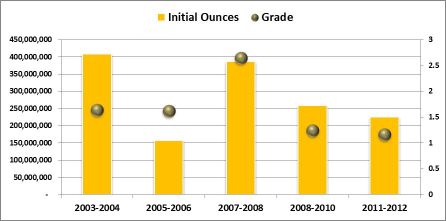
    A new study from IntierraRMG research and data provider to a disturbing trend in terms of a decrease in new global discoveries, especially in the gold grades. According to a study covering announced gold deposit finds over the past 10 years, has been the decline accelerated during the past four years, and if this trend continues, which seems likely, deposits easier to find and probably mostly already been discovered, then the future of the world’s supply of gold mined gradually become affected. And has already been the world production of gold mined and despite plateauing respectively in or around historically high levels, and the amount of new gold that is found reduces, then levels global production may not be sustainable beyond the next few years unless there is a dramatic shift in discoveries.

    Discover data IntierraRMG and analysis shows that the period of 2 years from 2003 to 2004 was the best in the scope of the study, with more than 400 million ounces of new gold. This includes ounces inferred and indicated measured with an average of 1.65 degrees grams per tonne. In contrast, in 2005 and 2006 the lowest number, with about 150 million ounces of gold discovered new – albeit a similar estimate.

    Then increased significantly discoveries during 2007 2008 with an increase of 390 million ounces. Average grade has also increased significantly to 2.65 grams per tonne, and the highest in the 10-year period.

    Over the next two years, was discovered a little more than 250 million ounces with a low of 1.25 grams per tonne. This deterioration continued during 2011 and 2012 and the amount of new gold ounces discovered decreased 225,000,000 ounces with a low degree stood at 1.17 grams per tonne.

    In this 10 year period of the study, Africa led the way with new discoveries of 479 million ounces of gold with an average grade of 2.8 grams per tonne. North America was next, although new ounces much less than 290 million people, and much less appreciated than 1.3 grams per tonne.

    Europe was the third most new discoveries with 240 million ounces, but with a high degree of North America of 2.0 grams per tonne. While South America saw Australia recorded 188,000,000 ounces, 74 million ounces of new discoveries with an average grade of 1.4 grams per tonne.

    Glenn Jones concluded, the Western Hemisphere manager IntierraRMG “with the global decline in drilling activity, IntierraRMG expectations that the next few years this trend will continue with a smaller number of new gold discoveries.”

    While the study indicate the direction IntierraRMG discovery will continue to decline – but may also fall sharply in the near future given that they face in time very difficult by the explorers gold young that are sure to reduce drilling activity significantly – improved detection techniques can reverse the trend In the medium and long term. But this would also suggest that the major new deposits found may be increasingly harsh in the sites and geological conditions. As we have seen in the past two years the demand for spending huge sums in the capital is now necessary to put some of the existing super deposits range drop a large degree has diminished significantly, and even more so in areas that have experienced high risk, although can eventually these mined this may Do not be so in the future.

  • Gold shines in Dubai as trade said to hit record $70bn in 2012

    Gold glitters in Dubai and Trade said to reach a record $ 70bn in 2012

    Dubai’s gold trade is estimated to have exceeded $70 billion in 2012, hitting record highs as more of the precious metal is exchanged and stored in the emirate.

    Official figures show the gold trade was worth around $56 billion in 2011, and the figure for last year is estimated to be at least 25 percent higher.

    Ahmed Bin Sulayem, executive chairman of the Dubai Multi Commodities Centre (DMCC), attributed the rise to greater confidence in the market and the trading infrastructure in the emirate.

    “We expected that the gold-trade value would go down but it went up and reached $50 billion [in 2011]. I’m hearing numbers of $70 billion for last year in gold – or $80 billion,” said Mr Bin Sulayem.

    Dubai’s gold trade was worth just $6 billion in 2003, according to the DMCC website, which quotes figures from Dubai Customs. That rose to $56 billion in 2011, made up of $33 billion in imports and $23 billion in exports.

    Mr Bin Sulayem said official figures for Dubai’s gold trade in 2012 would be issued soon. But other experts shared his confident early estimates for last year.

    Jeff Rhodes, the global head of precious metals and chief executive of INTL Commodities at the DMCC, said that Mr Bin Sulayem’s lower estimate of $70 billion was “credible”.

    “$70 billion sounds quite possible,” said Mr Rhodes. “The growth of the gold industry in Dubai has been fantastic, certainly since the DMCC was created.”

    Mr Rhodes attributed the rise in Dubai’s gold trade over the last ten years to both increased tonnage of gold traded, and the rising price of the precious metal. “That’s had a multiplier effect. The price of gold has gone up five or six times over that period,” he said.

    Mr Rhodes acknowledged however that gold prices over the last six months are “sharply lower”.

    The Dubai Gold and Commodities Exchange (DGCX), which is part of the DMCC, said recently it plans to launch the UAE’s first-ever spot gold contracts, which will allow investors in the country to buy and sell physical gold on a domestic exchange.

    Mr Bin Sulayem confirmed the plans in an interview with Al Arabiya.

    “Gold spot trading is going to be there, and we’ll have a full cycle of gold trading in Dubai… It will [happen] this year,” he said. “[The DGCX] is a fully-fledged UAE gold and commodities exchange. You have the attraction of no taxes, freedom of trade, ease of business.”

    DMCC, which is located in the Jumeirah Lakes Towers district of Dubai, has subterranean vaults used to store gold and other precious items.

    Mr Bin Sulayem said an increase in fees to store gold in Switzerland has led to a boost in gold deposits in Dubai.

    “These fees that went up shocked [investors] – they never saw this coming. And that is a huge turn-off to investors,” he said. “When they come to DMCC and set up shop, they know that for 50 years there’s no tax hikes and everything is standard. But when Switzerland does that, they get paranoid with all the stories in Europe – the Libor scandal, and the issues that the euro zone is facing, Cyprus… They’ll move to a safer place. And I’m proud to say that DMCC is that place.”

    Increased confidence is also seeing a shift in business to Dubai, Mr Bin Sulayem added.

    “You’re sitting above one of the largest vaults in the world. In the very short term that vault will be full,” he said.

    “You’re going to see more storage coming in Dubai. Because it’s not about just the cost… You have to look at what is causing the investors to bring their valuables and store them in Dubai. And if I was to sum it up in one word, it’s confidence.”

  • Gold price higher in sideways range; Cyprus, FOMC create no waves

    Gold price higher in sideways range; Cyprus, FOMC create no waves

    Is Selling gold reserve for market stabilization  now necessary ?

    Gold moved fractionally higher on Thursday morning but remained trapped in its newly elevated $1,600-1,620 range, with fears over the stability of Cyprus failing to fuel risk aversion to force a break.

    Spot metal was last at $1,607.80/1,608.60 per ounce.

    “The market seems to be waiting to see how the EU bails Cyprus out, although generally we feel non-policymakers are probably relieved that Cyprus rejected the levy on bank deposits – that sends a strong signal to the EU not to try such a measure in the wider arena,” FastMarkets analyst William Adams said.

    “That might well explain the kneejerk positive reaction in risk assets yesterday but it still leaves the Cyprus issue unsolved, which could lead to more trouble for the markets,” he added.

    On Monday, gold broke above $1,600 for the first time since February while market participants awaited the Cypriot vote. This was heavily defeated in the country’s legislature and President Nicos Anastasiades moved the deadline for a bailout deal to be reached today.

    He also confirmed that discussions with Russia are continuing – many wealthy Russians use Cyprus as an investment haven and will be hard-hit in case of a levy on large deposits.

    A troika of lenders – the EU, the ECB and the IMF – agreed a bailout deal for Cyprus last Saturday on condition that the country raises another 5.8 billion euros.

    The euro was last at 1.291 against the dollar, down a quarter of a cent on the close but still holding above the four-week lows of 1.2841 set two days ago.

    In the US, traders yesterday struggled to decipher a particularly cryptic line in the Federal Open Market Committee policy statement regarding the effectiveness of quantitative easing.

    “In determining the size, pace, and composition of its asset purchases, the committee will continue to take appropriate account of the likely efficacy and costs of such purchases as well as the extent of progress toward its economic objectives,” the FOMC statement said.

    “This appears to be a nod to critics who worry about the size of the balance sheet and the possible unintended consequences of such a large programme,” a US-based metals trader said.

    “Bernanke is saying: ‘Hey guys and girls, we know that there are costs and risks [involved with QE] and we are monitoring them constantly. But we think we’re going down the right path so just give us a little more time’,” the trader said.

    Japan is also considering further easing, with new chief central banker Haruhiko Kuroda starting work today. Kuroda has declared his intention to target inflation of two percent “as soon as humanly possible”.

    In wider markets, Asian stocks are mixed – the Hang Seng slipped 30 points to 22,225 but the Nikkei added more than one percent to 12,635. The FTSE 100 is down 0.8 percent and the Dax fell nearly one percent.

    Industrial commodities are mostly firmer. Brent crude oil is up one cent at $108.23 per barrel while three-month copper on the LME gained $18.25 to $7,638.25 per tonne.

    In the other metals, platinum recovered somewhat, gaining $4 to $1,576/1,586 per ounce but palladium edged $1 lower to $755/761 per ounce. Silver is up seven cents at $28.86/28.94.

  • Has the Gold Price Turned the Corner?

    Has the Gold Price Turned the Corner?

    Has the Gold Price Turned the Corner?

    Gold bounced off $1,560 a target that it had held for the last year and more. It consolidated at $1,580 and has now tackled $1,600.The bounce was off the long-term trend line. While resistance in the higher $1,600 area could be formidable a look at the reasons why it fell through support at $1,650 is worthwhile.

    Recent Fundamentals

    The prime cause of the gold price falling so much in the last few months, has been the over 100 tonnes of sales from the SPDR gold Exchange Traded Fund, an amount that triggered a considerable amount of stop loss selling.

    While central banks have been buying, their way of buying is to target available volumes of gold sitting in the market. Dealers with gold contact central banks and make an offer, which is accepted. Central banks don’t chase prices and find their stock as prices fall. This takes gold off the market leaving smaller amounts for buyers once the gold price turns up.

    A negative fundamental that has surprised many is the fall off in Indian demand as the government there raised duties on gold and have required “know your client” documentation on large retail purchases of gold. With their hatred of exposing their finances to government scrutiny, these measures have and are slowing Indian demand. But India is no stranger to buying gold when their government doesn’t want them to. So they will be back, even if we won’t be able to accurately quantify their buying in the future.

    Until recently the absence of Indian demand allowed short-term traders and speculators, alongside the sellers from the SPDR gold Exchange Traded Fund to dominate the gold price.

    But after the end of the Chinese Lunar New Year, we saw a steady rise in Chinese demand that has grown, while sales from the SPDR gold ETF have waned and have now turned to buying gold again.

    If the gold price continues to rise, even gently, it will squeeze short-term operators and push them to go long. But the stock they sold off just isn’t there anymore. That’s why this last week we have seen New York then Asia taking the gold price higher.

    The changes from a selling market to a halt in sales have allowed demand from China to take gold higher.

    Then Cyprus

    A concept that was regarded as an unrepeatable piece of history happened this weekend. The word ‘confiscation’ came to life as depositors in Cyprus had money taken from their bank accounts as their banks were closed at the weekend. But history tells us that this is always the way that government works when it acts in its own interests, ahead of those of its citizens.

    It has sparked fears that if the Cypriot Parliament accepts these terms or any confiscation whatsoever, it sets a precedent that may well apply in the future to other situations in financially distressed nations. Now that the Cypriot government has rejected these terms and once the E.C.B. funding is cut off, we expect the resurrection of its old currency and Capital Controls to be imposed. Confiscation of private citizen’s money in all forms is now a future probability against which wise investors should protect themselves.

    Justice has gone, as depositors have done nothing wrong, but are paying the price for banker’s errors. The Cypriot Bankers did nothing wrong except trust the government bonds of their mother country Greece. This is a classic ripple effect.

    Cyprus has until Monday to agree the terms, which the E.U. has refused to budge on, after which the European Central Bank Funding will be cut off. It appears that the International Monetary Fund, during the negotiations, had even gone so far as to suggest a 40% cut on certain deposits or to freeze deposits for up to five to 10 years.

    Few people in the world believed that the monetary authorities had the power to impact depositors this way. Confiscation of deposits has set a precedent that will be the death knell for an E.U. Common Deposit Guarantee scheme. It intended that depositors would be the first to be repaid in insolvency. This so-called tax on depositors under €100,000 calls into question everything the EU has been trying to do to protect ordinary depositors and taxpayers from bank failures for the past five years.

    It will also change the reaction of depositors in nations where doubts rise over the soundness of banks. “Runs” on bank will now happen immediately the specter of crisis appears. Creditors and depositors will be reviewing their lending on a broad front to protect against such eventualities in the future.

    Cyprus had been reasonably stable before the financial collapse, but was rocked by the Greek bond restructuring as Banks in Cyprus had invested in Greek government bonds. But what dealt a fatal blow to Cyprus was the impediment to borrowing because of a credit downgrade to BB+, which made the Cypriot bonds unacceptable as collateral to the ECB, and certainly not viable on the public markets.

    Monetary System Damage

    Of far greater consequence is the blow to confidence in the entire monetary system. If it can be done in Europe in extreme times, it can be done anywhere. Prudent investors will be reviewing how to protect their assets on a broad front, not just in gold and silver.

    But gold and silver’s attraction has been enhanced as the blow to the reliability of governments, banks and savings is heavy. Trust has been damaged. The safety of deposits in banks is now called into question. Deposits under €100,000 were thought to have been insured and inviolate but the proposals from the E.U. and the I.M.F. mortally damaged the integrity of the E.U.’s monetary system.

    In reality the U.S. controls the I.M.F. The fact that it could have acted so aggressively has marred their name too. It tells us that such actions can occur anywhere in the world under similar conditions.

    Fall in Confidence, Trust & Integrity

    A fall-off in confidence in the monetary system is one of the reasons that Asian nations have stopped increasing their dollar holdings and emerging nations across a broad spectrum have been buying gold and will continue to do so long-term.

    Why should these moves have caused so much damage? Because currencies hold value as long as its users believe it holds that value. The moment you hurt that value in individual holder’s hands, you damage that value and the credibility of that type of money. The draconian actions of the E.U. and I.M.F. question that value and the very value of savings in banks. The principle that you can keep your savings provided your government doesn’t need them is now established in investor’s minds.

    This has a direct but invisible impact on the value of gold and silver. The precious metals can be held beyond the reach of government (in India there is around 20,000 tonnes of gold hidden away in private hands and out of sight of their government) should be part of an investors criteria.

    In the developed world, very few individuals hold gold in the way the Indian investor does. There he still trusts his government and his bank to be loyal, faithful guardians of all his assets. The concept of holding assets outside the reach of government, legally, has not gained traction yet. But the actions of the E.U. and the I.M.F. have damaged that trust, making the investor think of ways to guard against such confiscation.

    Gold Price Turning the Corner

    Short-term the gold price is not moving on the Cyprus story. It is moving, quite simply, on the cessation of sales of gold from the SPDR gold Exchange Traded Fund and because Chinese demand is of sufficient quantity to move the price up. Gold is once again being bought by this fund and speculators are being forced to turn their short positions into long ones.

    So how should we treat the Cyprus debacle in terms of precious metal prices? It has caused a structural change in investors’ views on savings and on the control they have on their money. As part of effective saving of wealth, investors have to try to find ways of removing the potential threat to their wealth from monetary authorities.

    To ignore that threat would be to become a lemming, following the herd ahead, no matter the final fall that will certainly come. It makes gold more attractive and silver too. It moves precious metals from a temporary investment to a core investment. But holding precious metals out of the reach of government and the penalties that could attend holding them will become the preferred way forward. After all what’s the point of investments at all, if governments can simply walk in and take a chunk out of them, particularly when you made a wise investment but your bank didn’t?

    So long-term, the Cyprus debacle has lowered confidence in the monetary system and raised it in precious metals, which will eventually have a significantly positive impact on gold and silver prices.

  • Gold upward price momentum is likely to remain

    Gold upward price momentum is likely to remain

    Gold upward price momentum is likely to remain

    The eurozone’s deliberation on a bailout for Cyprus drove up the gold price but chances are slim for the metal to maintain the upward momentum, an expert with Emirates NBD said here on Saturday.

    Gerhard Schubert, head of the banks’ precious metals department, said in a weekly report that whenever the world encounters financial uncertainties, gold is the biggest beneficiary.

    The gold price went up by 17 U.S. dollars and reached 1,609 U.S. dollars an ounce on Friday.

    Schubert noted the metal could continue to be under pressure until it breaks two important price levels. “It first has to break 1,620 U.S. dollars convincingly and then move above 1,710 U.S. dollars,” Schubert said on future outlook.

  • Gold Price Climbed to Rs 30,370

    Gold Price Climbed to Rs 30,370

    Gold Price Climbed to Rs 30,370

    It was noted that the mixed trend in the bullion market during the past week as gold prices rose more continuous stockists buying influenced by the direction of global stability, while silver fell to a lack of support from industrial units.

    Traders said continued buying by stockists and stability of the global trend mainly led to the rise in gold prices for the second week in a row.

    They said silver remained under pressure on lack of support from industrial units and surrendered the Earth’s freshwater.

    Gold rose in New York, which usually determines the price trend on the domestic front, 0.8 percent to 1609 USD an ounce this week.

    In the New Delhi, began gold purity 99.9 percent and 99.5 higher and rose to 30370 rupees and Rs 30170 in 10 grams led to increase posters leading global cues.

    Later, it met with some resistance and declined to close at Rs 30,255 and Rs 30,055 in 10 grams, respectively, is still higher than the 245 rupees each.

    Sovereigns also rose Rs 50 to 25300 per piece of eight gram.

    On the other hand, silver ready rose, after a better start, for 55,180 rupees per kg and 54,835 before ending at Rs 54,415, suggesting a modest fall Rs 60. Similarly, the silver weekly-based delivery lost Rs 100 to 54200 rupees per kilogram during the week.

    However, silver attracted active buying rupees, up by 2,000 to 82,000 rupees buying and Rs 83,000 for selling 100 pieces.

  • Croatian Exotic Gold Coins

    Croatian Exotic Gold Coins

    Croatian Exotic Gold Coins

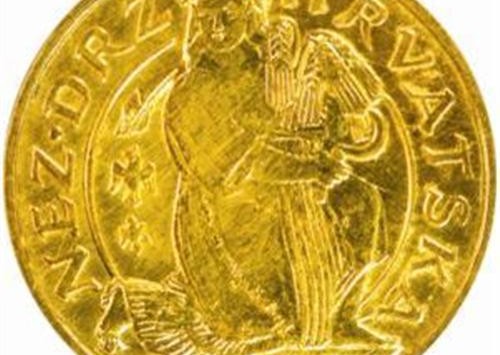
    A land that was once residences of ancient Neanderthals, and now, Croatia is to be a new member of the European Union, have gold coins worth mentioning.

    The IMF classified the country as a developing economy nowadays, and Croatia was part of Yugoslavia under the famous leader, Tito. It was one of the most flourishing countries in Eastern Europe due to its neutral foreign policies. Croatians didn’t need visas to travel from one country to another, as the part of the 1960s NAM along with Egypt’s Jamal Abed El-Nasser and India’s Mahatma Gandhi.

    It was a part of the Hungarian and the Austrian rule from the 16th century till the World Wars I & II. And before that, it fought the Ottoman Empire for nearly 2 long centuries.

    There might be no gold production now in Croatia, and it is one of the countries that have no gold reserves. The Croatian gold reserve might have been stolen during the chaos that followed the fall of the Soviet Union iron curtain. The truth is, no one knows for sure what happened back there.

    Nevertheless, Croatia issues gold coins. There are available Croatian gold 20 Kuna coins minted in 2010 in 5,000 pieces. Also, there are 1994 Dukat coins, 1000 and 500 Kuna coins, and the old 1941 gold coins of 500 Kuna. The price ranges from $150 and $400.

    For gold coins collectors, especially generalists, these gold coins are worth considering.